
Strikeborn Combat: Air Combos & M1s
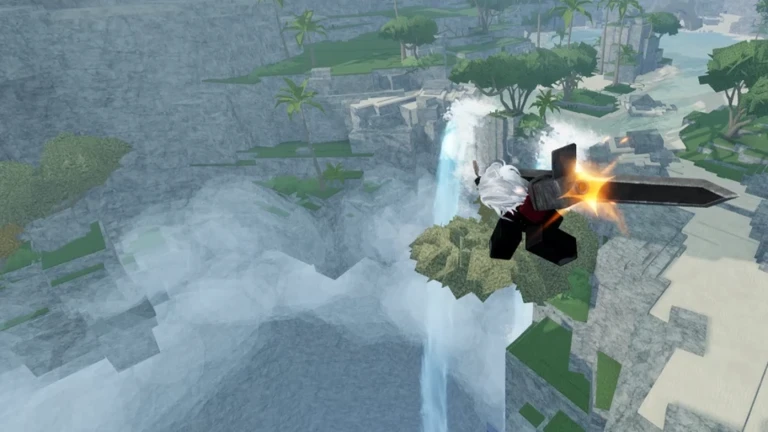
Strikeborn’s identity is not the anime licenses — it is the way a grounded M1 string turns into a real air route, the way skills change when you hold a direction, and the way the waterfall map lets you wall-jump or pad-launch instead of ending every combo on flat stone. This page is the shared fighting layer; the Yuji and Guts pages add kit-specific tools. Everything here comes from launch-week showcases and 1v1 sessions — no invented frame data, because SSSStudio has published none.
M1 theory: the string is reversed
Battlegrounds M1s are usually a four-hit family where the fourth hit launches. Strikeborn is the opposite — in Guts’ test footage, hit three is the uppercut and hit four slams back down.
That single fact changes everything:
- If you buffer a skill on hit four expecting a pop-up, you will bury the opponent and drop your route.
- Decide before the string whether you want a down slam (ends the route: chip damage or an edge guard off the cliff) or an uppercut convert (starts the air route).
- For a convert, stop at the uppercut — do not auto-complete hit four — and jump or dash with the opponent as they pop up.
Yuji’s punches are faster with a shorter confirm window; Guts’ swings are slower with far more range. Same theory, different timing.
The air route, step by step
The skill gap in Strikeborn is the moment someone uppercuts, stays glued to the victim in the air, and keeps swinging while the victim cannot mash a grounded reversal:
- Land the uppercut (hit three of the string).
- Jump or dash with them — not after they have already peaked.
- Use one aerial skill you have already tested. Several skills have a different air version; Guts showcases called out air variants on slots 1 and 4.
- M1 again while you still have height.
- Exit before the ravine — wall-jump out or dash away. Pride combos that end with both of you falling into the mist are a donation to the third party watching you.
That last point matters more in Strikeborn than in any flat arena: a 12-hit cinematic over the waterfall is a beacon. In a 100-player lobby, take the two extra hits and dump your victim toward the void instead of completing the lab combo. The dump is the stock.
Directional and air variants
Test builds clearly had hold-back variants on at least one kit, plus the air variants above — closer to a 2D fighter or platform fighter than to “press 1 for the same clip every time”. Nobody has published the full variant table, so lab it yourself — ten minutes per character:
- Neutral, grounded: press 1, 2, 3, 4.
- Hold forward, repeat all four.
- Hold back, repeat all four.
- Jump, repeat all four.
- After an uppercut, repeat the ones that looked useful.
Write down anything that behaves as a counter, a grab, a projectile or a movement tool — those four categories are the vocabulary of every matchup.
Counters: guesses with a floor, not invincible buttons
Two confirmed counter behaviours, neither of which is a hold-block:
- Yuji’s kick works as a regular swing and as a counter — when you guess wrong, it whiffs as a normal attack instead of leaving you exposed.
- Guts’ slot 4 counts as a counter if it connects with an incoming attack and a normal swing if it does not — the same “guess with a floor” design.
Use counters when you see a pattern: a dash-in from a player who always presses a skill on wakeup, or an opponent whose approach is committed. Do not use them as brain-off panic buttons — they are reads, and repeated bad reads are free stocks for the other player.
Map control: the third fighter in every lobby
The arena is a character:
- Open stone courtyards favor Guts — anyone who walks forward with Yuji habits pays the tip-range tax.
- Ruins and tight walls favor Yuji — the fist wins once it gets inside the sword’s hilt.
- Cliff lips and the ravine are everyone’s win condition: a down slam or a well-timed dump near the edge is a stock regardless of health bars.
- Wall jumps and jump pads are approach, escape and combo-extension all at once. A route that ends with a wall jump into a second aerial is the current high-level texture of the game.
What we still don’t know
Cooldowns, damage values, exact launcher frames and the full variant tables are unpublished — this page will grow them only when SSSStudio documents a patch or the community settles verified labels. For now, the four-category lab method above is the honest way to build your own notes. Then take them to the tier list to pick your main, and check controls before you queue.